Oct 20, 2026
Singapore LTIR roundtable: Navigating the new fixed income landscape. In partnership with 100 Women in Finance
On 23 September, Eurex hosted a Long-Term Interest Rates (LTIR) roundtable in partnership with 100 Women in Finance, bringing together industry professionals for an insightful discussion on the evolving fixed income landscape. Moderated by Shruti Rao, Total Portfolio Risk and Asset Allocation at GIC, the panel featured Kerry Barr, Head of Trading APAC FICC and EMEA at BlackRock, and Jutta Frey-Hartenberger, Global Product Lead, Long-Term Interest Rate Futures & Options at Eurex. Together, they explored how investors are adapting to a higher-for-longer interest rate environment, changing market structures, and shifting sources of liquidity and risk transfer.
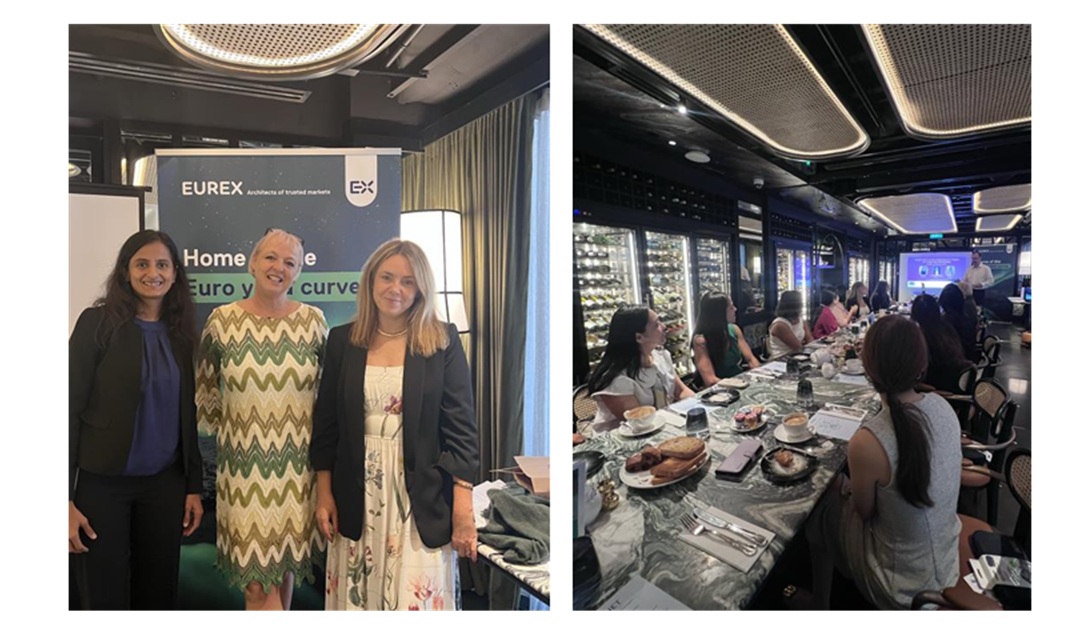
Key Takeaways from the Discussion
1. Financing and market absorption matter as much as rate direction
As central banks move away from quantitative easing and cease absorbing duration, the fixed income market must increasingly rely on private capital to absorb growing sovereign and corporate debt issuance. Funding requirements continue to rise, including significant capital demand linked to AI infrastructure investment.
While carry and term premiums have returned, financing costs are becoming an increasingly important component of total returns. As a result, market depth, liquidity and the price sensitivity of private capital are becoming just as important as the direction of interest rates themselves.
2. Balance sheet is now part of the trade
Higher capital requirements and leverage ratio constraints continue to limit dealer intermediation capacity. Consequently, financing, execution efficiency and instrument selection have become integral components of trade economics.
The impact is clearly visible in the cash-futures basis market, where multi-billion-euro weekly volumes continue to be traded across Bunds, BTPs and OATs. Debt management offices rely on primary dealers to absorb issuance, asset managers require efficient duration hedges, and relative-value funds seek to capture pricing dislocations between cash bonds, futures and swaps.
When repo markets tighten and physical bonds become expensive to finance, synthetic exposure through futures or swaps can become significantly more cost-efficient. This has increased the focus on balance sheet efficiency and financing optimisation across the investment process.
3. Duration is no longer a single factor risk
Participants noted that duration can no longer be viewed as one uniform source of risk.
The front end of the curve, particularly the 2–5 year sector, remains closely linked to monetary policy expectations and central bank rate paths. By contrast, the 10-30 year segment increasingly behaves as a macroeconomic risk factor driven by fiscal deficits, structural capital demand, inflation uncertainty and term premiums.
As a result, portfolios with similar headline duration can exhibit very different performance characteristics depending on their positioning along the curve. Institutional investors are increasingly separating underlying asset holdings from risk overlays and actively managing duration, curve exposure and convexity through futures, swaps and repo markets.
4. The emergence of the EU yield curve
The discussion also highlighted the growing importance of the European Union as a standalone issuer. EU debt issuance has expanded from approximately €50 billion in 2020 to more than €900 billion today, and is expected to exceed €1 trillion by the end of 2026.
At this scale, the EU now represents nearly 40% of all AAA-rated European government debt and has become the fifth-largest issuer in Europe, comparable in size to Spain.
Supported by a growing primary dealer network and expanding derivatives liquidity, the EU is increasingly being viewed as a distinct AAA yield curve alongside national sovereign issuers.
Eurex’s physically delivered EU Bond Future (FBEU) brings standardized derivatives liquidity to this curve, offering a single, unified instrument that captures the common European rate dynamics shared across all member states: The only derivatives product covering Europe as a whole, alongside expanding volumes across benchmark in German, French and Italian futures contracts.
5. Centralised risk management and around-the-clock trading
Advances in electronic trading, portfolio trading and centralized risk management are increasingly decoupling risk transfer from the opening hours of underlying cash markets.
Global portfolio managers are able to transfer risk across regions using centralized risk desks, while institutional investors in Asia continue to increase their holdings of European and U.S. fixed income assets. This has driven growing demand for access to benchmark rates products during APAC trading hours.
The ability to trade and hedge European and US rates markets on a near 24/7 basis is becoming an increasingly important feature of modern market structure, enabling investors to respond to market developments as they occur rather than waiting for local market openings.
Looking ahead
The fixed income market enters 2027 with carry and term premiums restored, but under fundamentally altered market dynamics. Financing costs, dealer balance sheet capacity, duration positioning, liquidity conditions and market structure are playing a greater role in investment outcomes than at any point in the post-financial crisis era.
The discussion highlighted that successful investing in this environment requires more than a view on the direction of rates. Understanding how capital is financed, how risk is transferred and where liquidity resides has become equally important in navigating today's rates markets.
